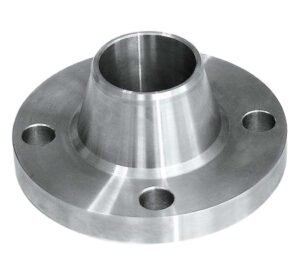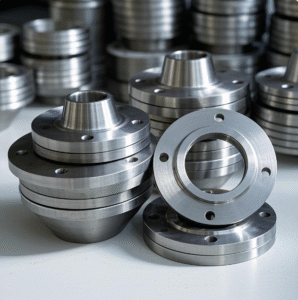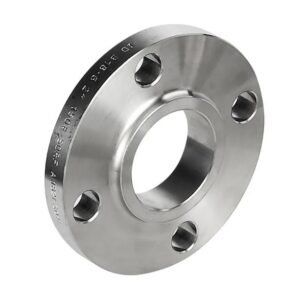
For ultra-clean pharmaceutical systems (e.g., WFI water, bioreactors), standard stainless flanges are contamination risks. A Ra ≤0.4μm electropolished mirror finish is non-negotiable to prevent biofilm adhesion, meet FDA/EMA guidelines, and enable steam sterilization. Here’s how to execute this for large DN400 (16″) SCH40S flanges.
1. Why Ra ≤0.4μm Matters in Pharma
-
Biofilm Risk: Surface roughness >0.5μm harbors Pseudomonas and endotoxins.
-
Cleanability: Ra 0.4μm reduces cleaning agent use by 40% vs. Ra 0.8μm (per PDA TR 61).
-
Compliance: ASME BPE-2019 mandates Ra ≤0.5μm for Product Contact Surfaces (PCS).
2. Step-by-Step Manufacturing Process
(For ASTM A182 F316L SCH40S Flanges)
Stage 1: Precision Machining
-
Tooling: Diamond-tipped CNC tools (avoid carbide to prevent inclusions).
-
Tolerance: ID/OD ±0.05mm (ASME B16.5 Table 8).
-
Surface Prep: Achieve Ra ≤1.2μm via progressive grinding (80 → 600 grit).
Stage 2: Mechanical Polishing
| Step | Abrasive | Grit | Target Ra |
|---|---|---|---|
| Rough Polish | SiC belts | 320 | ≤0.8μm |
| Intermediate | Al₂O₃ paste | 800 | ≤0.6μm |
| Final | Diamond suspension | 1,200+ | ≤0.4μm |
Critical: Use non-shedding cotton/polyester pads to avoid embedding fibers.
Stage 3: Electropolishing (Key to Ra 0.4μm)
-
Electrolyte: Phosphoric-Sulfuric Acid (70/30%) at 40°C.
-
Parameters:
-
Voltage: 12–15V DC
-
Current Density: 20–30 A/dm²
-
Immersion Time: 15 min (removes 15–20μm layer)
-
-
Validation: In-process monitoring with periscope cameras for uniformity.
3. Validation & Documentation
Mandatory Certificates:
-
ASME BPE-2019: Surface roughness report (profilometer trace).
-
FDA 21 CFR 211.65: Material Cert (ASTM A182 F316L with Mo≥2.1%).
-
ISO 13408-1: Sterilization validation data (SIP/CIP cycles).
-
Passivation Report: ASTM A967 Method C (nitric acid) with Fe<0.5μg/cm².
Testing Protocol:
| Test | Method | Acceptance Criteria |
|---|---|---|
| Surface Roughness | ASME B46.1 (profilometer) | Ra ≤0.4μm, Rmax ≤1.5μm |
| Residual Particles | ISO 16232-5 | ≤5 particles/cm² (>5μm) |
| Bioburden | USP <71> | ≤1 CFU/10 cm² |
4. Design for Cleanability
-
Flange Type: Use Sanitary Clamp (Tri-Clover) or Weld Neck (no threads/crevices).
-
Gasket: Seamless PTFE with Ra ≤0.4μm mirror finish.
-
Radii: All corners ≥3mm (prevents fluid entrapment).
5. Real-World Cost Breakdown
| Item | Standard Flange (Ra 1.6μm) | Mirror-Finished (Ra 0.4μm) |
|---|---|---|
| DN400 SCH40S Flange | $950 | $1,800 |
| Electropolishing | $200 | $600 |
| Validation Package | $100 | $1,200 |
| Total | $1,250 | $3,600 |
| *Justification: Avoids $50K+ in FDA non-compliance fines per incident.* |
6. Case Study: Vaccine Bioreactor Retrofit
-
Problem: Ra 0.8μm flanges caused endotoxin spikes in purified water loop.
-
Solution: Upgraded to Ra 0.4μm electropolished DN400 flanges.
-
Results:
-
Endotoxin levels: 0.001 EU/mL (from 0.25 EU/mL).
-
Sterilization cycles: Reduced from 4 to 2 weekly.
-
ROI: 14 months via reduced QC failures.
-
7. Pitfalls to Avoid
-
Fake “Mirror Finish”: Suppliers claiming Ra 0.4μm without profilometer reports.
-
Embedded Iron: Skip magnetic polishing tools (use non-ferrous abrasives).
-
Weld Contamination: Orbital weld inside flange bore with argon purge (O₂ <10 ppm).
Procurement Spec Template
复制
下载
MATERIAL: ASTM A182 F316L SCH40S (Mo≥2.1%, low S/Se)
FINISH: Electropolished to Ra ≤0.4μm (ASME BPE SF-1)
CERTIFICATION: EN 10204 3.1 + ASME BPE QR
TEST REPORTS:
  - Passivation per ASTM A967 Method C
  - SEM-EDS showing Cr/Fe ratio >1.0
  - 30-day immersion test in WFI (no corrosion)
Conclusion
Achieving Ra 0.4μm on large DN400 flanges demands:
-
Precision grinding → diamond polishing → controlled electropolishing.
-
Rigorous validation per ASME BPE/FDA.
-
Designing out crevices with sanitary connections.
Pro Tip: Partner with BPE-certified suppliers like Swagelok® or ITT Biopharm to avoid validation headaches.