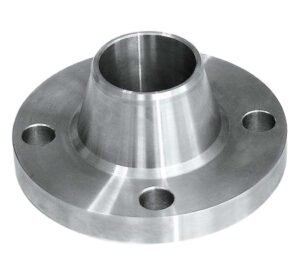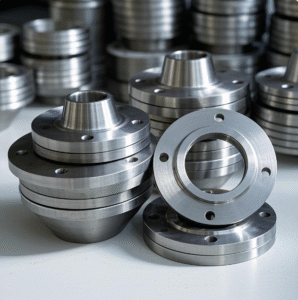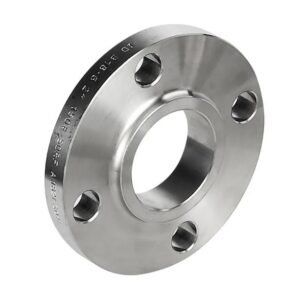
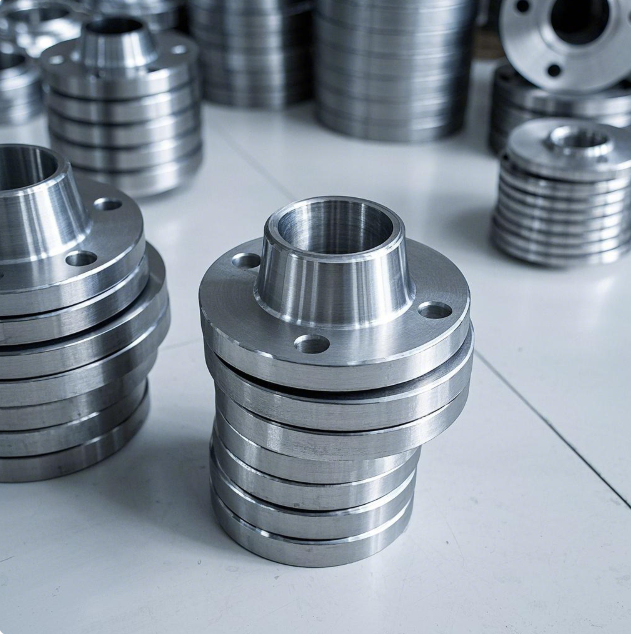
In chloride-rich environments—offshore rigs, chemical plants, or desalination systems—stainless steel flanges face relentless corrosion threats. While 316L austenitic stainless steel has been a traditional choice, Duplex 2205 (UNS S32205) is increasingly displacing it in critical applications. With superior strength, chloride resistance, and cost efficiency over its lifecycle, Duplex 2205 is redefining durability standards.
This guide combines 2024 lab test data, real-world case studies, and procurement strategies to explain why 2205 outperforms 316L in chloride environments—and how to source it wisely.
Why Chloride Environments Demand Duplex 2205
Chlorides (e.g., seawater, brine, or acidic fluids) attack stainless steel by:
-
Pitting Corrosion: Localized penetration of passive oxide layers.
-
Crevice Corrosion: Aggressive degradation in stagnant zones (e.g., under gaskets).
-
Stress Corrosion Cracking (SCC): Brittle fractures under tensile stress.
316L Limitations:
-
Lower pitting resistance equivalence (PRE = 26 vs. 2205’s 35+).
-
Susceptible to SCC at temperatures >60°C.
-
Limited mechanical strength (485 MPa vs. 2205’s 620 MPa yield strength).
Duplex 2205 Advantages:
-
Dual-phase (austenite + ferrite) microstructure resists crack propagation.
-
Higher chromium (22%), molybdenum (3%), and nitrogen (0.18%) for enhanced chloride resistance.
-
2x the yield strength of 316L, enabling thinner/lighter designs.
Lab Test Data: 2205 vs. 316L in Chloride Environments
Independent 2024 studies validate 2205’s dominance:
1. ASTM G48 (Pitting/Crevice Corrosion)
| Parameter | 316L | Duplex 2205 |
|---|---|---|
| Critical Pitting Temp (CPT) | 15°C (59°F) | 35°C (95°F) |
| Critical Crevice Temp (CCT) | 5°C (41°F) | 25°C (77°F) |
| Takeaway: 2205 withstands pitting in seawater 2x longer than 316L. |
2. ASTM G36 (Boiling Magnesium Chloride SCC Test)
-
316L: Cracks observed after 24 hours at 105°C.
-
2205: No cracking after 1,000 hours at 125°C.
-
Takeaway: 2205 resists SCC in high-temperature chloride solutions.
3. Seawater Immersion (12 Months, 25°C)
| Metric | 316L | 2205 |
|---|---|---|
| Corrosion Rate (mm/year) | 0.05 | 0.003 |
| Max Pit Depth (mm) | 0.8 | 0.1 |
-
Takeaway: 2205’s corrosion rate is 94% lower than 316L in stagnant seawater.
Case Study: Offshore Oil Platform Failure Prevention
A North Sea operator replaced 316L flanges with Duplex 2205 in 2022 after repeated leaks in seawater cooling systems. After 2 years:
-
Cost Savings: Reduced flange replacements by 70% ($1.2M saved).
-
Safety: Zero SCC or pitting failures in 2205 flanges.
-
Weight Reduction: Thinner 2205 flanges cut piping weight by 15%.
When to Choose Duplex 2205 Over 316L
Opt for 2205 if your application involves:
-
Chloride concentrations >1,000 ppm.
-
Temperatures above 60°C (140°F).
-
High-pressure or cyclic loading (e.g., subsea pipelines).
-
Sulfide-containing environments (e.g., oil and gas sour service).
6-Step Buyer’s Guide for Duplex 2205 Flanges
1. Verify Material Certifications
-
Mandatory Docs:
-
Mill Test Certificate (MTC) with heat number, chemical analysis, and mechanical properties.
-
ASTM A182 (forged flanges) or EN 10222 compliance.
-
NACE MR0175 certification for sour service.
-
2. Assess Manufacturing Expertise
-
Red Flag: Suppliers without duplex steel experience may mishandle heat treatment (solution annealing at 1020–1100°C is critical).
-
Ask For:
-
Microstructure reports (ferrite-austenite balance of ~50/50).
-
Proof of pickling/passivation to remove iron contamination.
-
3. Prioritize Localized Testing
-
Third-Party Tests:
-
PMI (Positive Material Identification): Confirm Cr, Mo, Ni, and N levels.
-
Hardness Testing: Max 32 HRC (per NACE MR0175).
-
Pitting Resistance: ASTM G48 Method A at 25°C.
-
4. Evaluate Total Cost of Ownership (TCO)
| Cost Factor | 316L | 2205 |
|---|---|---|
| Initial Cost (per flange) | $80 | $120 |
| Maintenance (10 years) | $200 | $50 |
| Replacement Rate | 2x over 10 years | 0.5x over 20 years |
| TCO/Flange (20 years) | $480 | $195 |
2205 offers 60% lower TCO despite higher upfront costs.
5. Negotiate Smartly
-
Bulk Discounts: 2205 flanges often see 10–15% discounts for 500+ units.
-
Payment Terms: Offer 40% upfront to secure better pricing.
6. Partner with Specialized Suppliers
-
Top Global 2205 Flange Manufacturers:
-
Sandvik (Sweden): Premium grades for subsea projects.
-
Outokumpu (Finland): Largest duplex producer.
-
Jindal Stainless (India): Cost-effective options with NACE compliance.
-
Red Flags in Supplier Proposals
-
“Equivalent” Grades: Substitutes like 2207 or 2507 may be over-specified.
-
No Nitrogen Analysis: Nitrogen (0.14–0.20%) is critical for 2205’s performance.
-
Missing NACE Reports: Essential for H₂S environments.
FAQ: Sourcing Duplex 2205 Flanges
Q: Can 2205 be welded to 316L piping?
A: Yes, but use 2209 filler metal and post-weld heat treatment to prevent sigma phase formation.
Q: Does 2205 require cathodic protection?
A: No—its passive film self-repairs, unlike carbon steel.
Q: How does 2205 compare to Super Duplex 2507?
A: 2507 has higher PRE (≥40) but costs 2x more. Use 2507 for ultra-high chloride/sour service.
Q: Are Chinese 2205 flanges reliable?
A: Only from certified mills like TISCO or Baosteel. Avoid uncertified “Duplex-like” alloys.