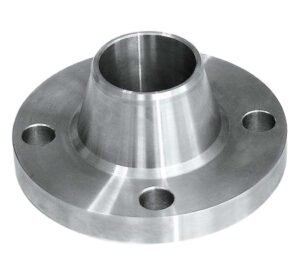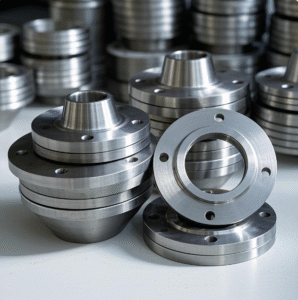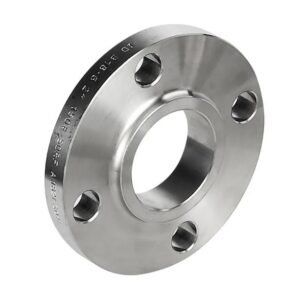

In the food, dairy, and pharmaceutical industries, equipment compliance with stringent hygiene standards is non-negotiable. Flanges, as critical connectors in processing systems, must adhere to 3-A SSI (Sanitary Standards Inc.) certification to prevent contamination, ensure cleanability, and withstand corrosive cleaning agents like CIP (Clean-in-Place) chemicals. Among stainless steels, 316Ti (Grade 1.4571) is a titanium-stabilized variant of 316L, offering enhanced resistance to sensitization and pitting. When combined with a surface roughness of Ra ≤0.8μm, it becomes the gold standard for food-grade flanges.
This guide breaks down the 3-A SSI requirements, the 316Ti manufacturing process, and how to achieve ultra-smooth surfaces for compliance.
Why 3-A SSI Certification Matters
3-A SSI standards ensure equipment meets hygienic design criteria for food contact surfaces. Key requirements for flanges:
-
Material Safety: Non-toxic, non-absorbent, and corrosion-resistant (316Ti meets FDA 21 CFR 178.2010).
-
Surface Finish: Ra ≤0.8μm to prevent bacterial adhesion and facilitate cleaning.
-
Seamless Design: No crevices or dead zones where microbes can accumulate.
-
Documentation: Full traceability of material heat numbers and processing steps.
Non-compliant flanges risk product recalls, regulatory fines, and reputational damage.
Why 316Ti Stainless Steel?
316Ti (UNS S31635) contains titanium (5xC min) to stabilize the alloy against chromium carbide precipitation during welding, making it ideal for high-temperature processes like pasteurization.
| Property | 316Ti vs. 316L |
|---|---|
| Corrosion Resistance | Superior in chloride-rich CIP solutions (e.g., hypochlorite). |
| Weldability | Reduced risk of sensitization in HAZ (Heat-Affected Zone). |
| Thermal Stability | Maintains integrity at temps up to 800°F (427°C). |
| Cost | 10–15% higher than 316L, but justified for critical zones. |
Achieving Ra ≤0.8μm Surface Roughness: Manufacturing Process
Step 1: Precision Forging
-
Material: Start with ASTM A182 F316Ti forged blanks.
-
Process: Closed-die forging to minimize porosity and ensure uniform grain structure.
Step 2: Machining
-
CNC Turning: Achieve dimensional accuracy per ASME B16.5 or DIN 11851 (food industry standard).
-
Surface Prep: Remove tool marks with progressive grit polishing (80 → 120 → 220 → 320).
Step 3: Mechanical Polishing
-
Initial Polish: Use non-woven abrasive belts (400–600 grit) to reduce Ra to ~1.2μm.
-
Final Polish: Buff with silicone-based compounds and microfiber wheels to achieve Ra ≤0.8μm.
Step 4: Electropolishing
-
Process: Immerse flanges in a phosphoric/sulfuric acid bath at 20–50°C. Apply 10–20V DC to remove 10–30μm of surface layer.
-
Benefits:
-
Smooths peaks/valleys, reducing Ra by 30–50%.
-
Passivates the surface, enhancing corrosion resistance.
-
Removes embedded iron particles.
-
Step 5: Quality Control
-
Surface Roughness Test: Use profilometers (e.g., Mitutoyo SJ-410) to verify Ra ≤0.8μm.
-
Passivation Test: ASTM A967 nitric acid method to confirm chromium oxide layer integrity.
-
3-A Audit: Third-party inspectors validate design and documentation.
Critical Compliance Considerations
-
No Threads or Grooves: ASME BPE (Bioprocessing Equipment) standards prohibit threaded connections in food zones. Use sanitary clamp or weld-neck flanges.
-
Radiused Edges: All transitions must have a minimum 1/4″ radius to avoid crevices.
-
Material Traceability: Mill Test Certificates (MTCs) must include:
-
Heat number, chemical analysis (Cr, Mo, Ti, C).
-
Heat treatment records (solution annealing at 1040–1120°C).
-
Common Mistakes & Fixes
| Mistake | Risk | Solution |
|---|---|---|
| Using 316L instead of 316Ti | Sensitization in welded areas | Specify 316Ti for weld-heavy systems. |
| Over-polishing | Work hardening, reduced Ra | Control polishing pressure and time. |
| Skipping electropolishing | Residual micro-crevices | Mandate electropolishing step. |
Case Study: Dairy Processing Plant Upgrade
A European dairy replaced 316L slip-on flanges (Ra 1.6μm) with 3-A SSI-certified 316Ti weld-neck flanges (Ra 0.6μm). Results:
-
Contamination Incidents: Reduced from 3/year to 0 over 2 years.
-
CIP Efficiency: Cleaning time cut by 25% due to smoother surfaces.
-
ROI: Achieved in 18 months via reduced downtime and recall risks.
Cost Comparison: 316Ti vs. Alternatives
| Material | Cost per Flange (DN50, 150LB) | Surface Finish Cost | 3-A Compliance |
|---|---|---|---|
| 316Ti | $180–$220 | +$30–$50 (electropolish) | Yes |
| 316L | $150–$180 | +$20–$40 | No (unless upgraded) |
| Alloy 2507 | $350–$450 | +$50–$70 | Overkill for most |
FAQ: 3-A SSI Flanges
Q: Can existing 316L flanges be upgraded to 3-A compliance?
A: Only if re-machined, polished, and electropolished to Ra ≤0.8μm.
Q: Is 316Ti necessary for cold storage systems?
A: Yes—CIP chemicals (even in cold temps) demand 316Ti’s chloride resistance.
Q: How often should surface roughness be tested?
A: Batch testing + annual audits for certified suppliers.
Q: Are laser-clad flanges 3-A compliant?
A: Yes, if post-processed to Ra ≤0.8μm and crevice-free.