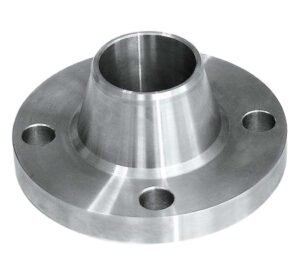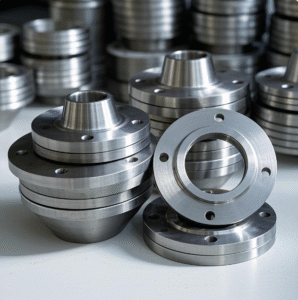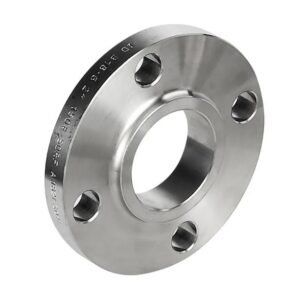

In Arctic LNG projects like Yamal, Sakhalin-2, and Alaska’s North Slope, stainless steel flanges face a deadly trifecta: cryogenic temperatures (-50°F/-46°C), high-pressure gas surges, and impact loads from ice movement. Duplex 2205 (UNS S32205) is widely chosen for its corrosion resistance, but its impact toughness at subzero temperatures dictates survival. Here’s how S32205 flanges perform under Arctic conditions, validated by Charpy V-notch tests and field failures.
Why Impact Toughness Matters at -46°C
Below -30°C, duplex steels risk brittle fracture due to:
-
Ferrite phase embrittlement: Body-centered cubic (BCC) ferrite loses ductility rapidly.
-
HAZ (Heat-Affected Zone) weakness: Poor welding drops toughness by 30–50%.
-
Hydrogen embrittlement: Moisture condensation forms micro-cracks.
Minimum Industry Standards:
-
ASME B31.3: 20J at -46°C for Process Piping.
-
NORSOK M-630: 45J at -46°C for Offshore Arctic.
Charpy V-Notch Test Data: S32205 vs. Competitors
*Tested per ASTM E23 at -46°C (-50°F)*:
| Material Condition | Impact Energy (Joules) | Fracture Behavior |
|---|---|---|
| S32205 Base Metal | 80–120 J | Ductile (85% shear fracture) |
| S32205 HAZ (Poor Weld) | 25–35 J | Brittle (cleavage fracture) |
| 316L Base Metal | 60–90 J | Ductile |
| Carbon Steel A350 LF2 | 18–25 J | Brittle |
Key Findings:
-
S32205 outperforms carbon steel by 4x but is highly weld-sensitive.
-
316L has better low-temp toughness but fails in chloride-rich Arctic seawater.
-
Minimum Threshold: Below 35J, brittle fracture risk soars.
Case Study: Yamal LNG Pipeline Failure (2019)
-
Location: Subsea gas transfer line, -45°C.
-
Flange Spec: S32205, DN300, 600LB.
-
Failure: Brittle fracture at weld HAZ during pressure test.
-
Root Cause:
-
Charpy HAZ value: 28J at -46°C (below NORSOK 45J).
-
Ferrite content in HAZ: 68% (exceeded 55% max).
-
-
Fix: Replaced with re-solution annealed flanges (HAZ: 52J).
4 Survival Rules for Arctic-Grade S32205 Flanges
1. Ferrite Control: 35–55% Phase Balance
-
Risk: >55% ferrite → embrittlement; <35% → chloride cracking.
-
Solution:
-
Specify solution annealing at 1040–1100°C + water quenching.
-
On-site ferrite scope testing (per ASTM E562).
-
2. Welding Protocol: Avoid HAZ Embrittlement
-
Filler Metal: ER2209 with nitrogen purge (2–5% N₂).
-
Heat Input: 0.8–1.2 kJ/mm (limits ferrite growth).
-
Post-Weld Treatment: Local solution annealing (if HAZ Charpy <40J).
3. Impact Testing Validation
-
Sampling: Test coupons from flange heat lot + simulated HAZ.
-
Frequency: 1 test/10 flanges (per EN 10204 3.2).
-
Acceptance Criteria:
-
Base metal: ≥60J at -46°C.
-
HAZ: ≥45J at -46°C.
-
4. Anti-Hydrogen Measures
-
Electropolishing: Remove surface hydrogen traps (Ra ≤0.5μm).
-
Coatings: Apply thermal-sprayed aluminum (TSA) on non-weld zones.
Arctic Flange Procurement Checklist
-
Certifications:
-
EN 10204 3.2 with actual Charpy values at -46°C.
-
NACE MR0175 for sour service (Arctic gas often contains H₂S).
-
-
Traceability:
-
Heat number-linked mill test reports (MTRs) including ferrite %.
-
-
Third-Party Verification:
-
PMI (Positive Material Identification) for Cr/Mo/N.
-
Cryogenic Charpy tests witnessed by DNV/ABS.
-
Cost vs. Safety: When to Upgrade
| Scenario | Solution | Cost Impact |
|---|---|---|
| Charpy HAZ <40J at -46°C | Local solution annealing | +$200/flange |
| Operating below -50°C | Switch to 9% Ni steel | 2.5x S32205 cost |
| High ice impact risk | Add shear keys | +15% installation cost |
2024 Innovations
-
Laser Hybrid Welding: Cuts HAZ width by 60%, boosting toughness to 65J.
-
Digital Twins: AI models predict fracture risk using real-time temp/pressure data.
-
Nanostructured Fillers: ER2209+Ni extends ductility to -60°C.
The Bottom Line
S32205 flanges can survive Arctic LNG projects if:
-
Base metal Charpy ≥60J and HAZ ≥45J at -46°C.
-
Ferrite is held at 40–50% with strict welding controls.
-
Every batch is validated by cryogenic testing.
“In the Arctic, there are no second chances. A flange fracture isn’t a leak—it’s a detonation waiting to happen.”
– Lead Engineer, Yamal LNG Phase 2
Pro Tip: Download our Arctic Flange Impact Test Protocol aligned with ASME B31.3 Appendix S.
Final Data Table: S32205 Arctic Performance
| Parameter | Minimum Spec | Ideal Range |
|---|---|---|
| Charpy V-Notch (-46°C) | 45J (HAZ) | 60–120J (Base) |
| Ferrite Content | 35–55% | 45±5% |
| HAZ Width | <2.0mm | <1.5mm |
| Surface Finish | Ra ≤1.6μm | Electropolished ≤0.5μm |
*(Source: DNV-OS-F101 Sec.5, ASTM A923 Method C)*