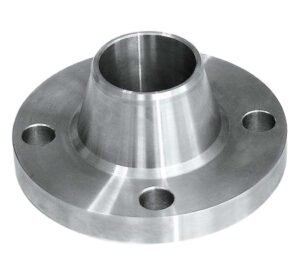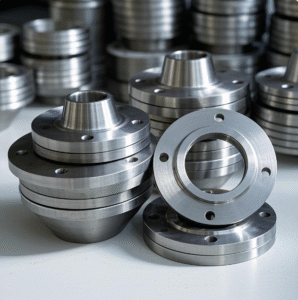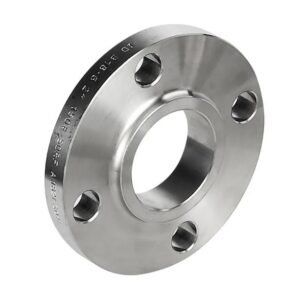
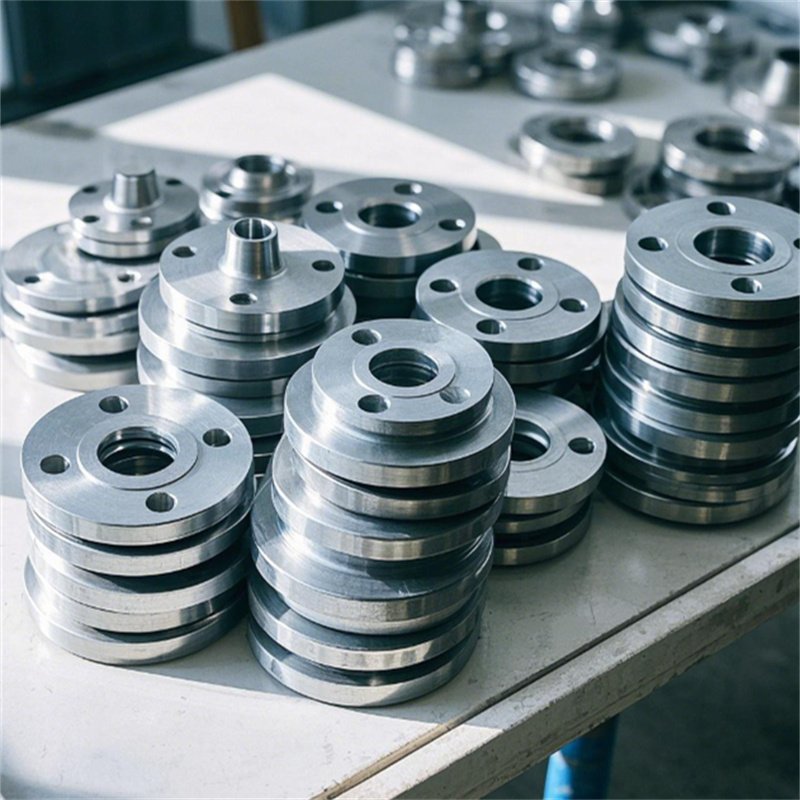
The shift from traditional austenitic stainless steels (304/316) to advanced dual-phase alloys like 25Cr-7Ni-3Mo (UNS S32550/S32750) represents a quantum leap in flange performance for critical applications. Below, we dissect their microstructures, phase interactions, and real-world implications using metallurgical data and industry case studies.
1. Microstructural Fundamentals
| Property | 304/316 (Austenitic) | 25Cr-7Ni-3Mo (Dual-Phase) |
|---|---|---|
| Crystal Structure | Face-Centered Cubic (FCC) | 50% FCC Austenite + 50% BCC Ferrite |
| Key Alloy Elements | Cr 18%, Ni 8–10%, Mo 0–2.1% | Cr 25%, Ni 7%, Mo 3–4%, N 0.3% |
| Phase Balance | 100% Austenite | 45–55% Ferrite/Austenite |
| Grain Size | 20–50 μm | 5–15 μm (finer grains) |
Why Microstructure Matters:
-
Ferrite (BCC): High strength, chloride stress corrosion cracking (Cl-SCC) resistance.
-
Austenite (FCC): Ductility, toughness, weldability.
-
Phase Boundaries: Block crack propagation and enhance corrosion resistance.
2. Phase-Specific Property Comparison
A. Corrosion Resistance
| Test | 316L | 25Cr-7Ni-3Mo |
|---|---|---|
| PREN (Cr+3.3Mo+16N) | 25–28 | 42–48 |
| CPT (ASTM G48) | 25°C | >50°C |
| CCT (ASTM G78) | 15°C | 35°C |
| H₂S SCC (NACE TM0177) | Fails at 50 ppm | Resists >10,000 ppm |
*25Cr-7Ni-3Mo’s high Cr/Mo/N forms a Cr₂O₃-MoO₃-N-rich passive layer, resisting pitting even in 100,000 ppm Cl⁻.*
B. Mechanical Strength
| Property | 316L | 25Cr-7Ni-3Mo |
|---|---|---|
| Yield Strength | 170 MPa | 550 MPa |
| Tensile Strength | 485 MPa | 800 MPa |
| Hardness | 150 HBW | 290 HBW |
| Impact Toughness | 100J at -20°C | 80J at -40°C |
*Dual-phase steel achieves 3x higher yield strength than 316L, enabling thinner/ligher flanges.*
3. Weld Zone Microstructure: The Failure Frontier
304/316 Weaknesses
-
Sensitization: Cr-carbides precipitate at 450–850°C, depleting Cr near grain boundaries → intergranular corrosion.
-
HAZ Cracking: Austenite’s low thermal conductivity causes residual stresses.
25Cr-7Ni-3Mo Advantages
-
No Sensitization: N replaces C, inhibiting Cr-carbide formation.
-
Controlled HAZ: Laser welding limits ferrite growth to 55–60% (vs. 70% in arc welding).
-
Filler Metal: ER2594 maintains phase balance (45/55).
Micrograph Analysis:
-
316L Weld: Chromium carbides along grain boundaries (black lines in etching).
-
Dual-Phase Weld: Clean phase boundaries with no carbides (Kalling’s reagent).
4. Real-World Performance Data
Case Study: Offshore Gas Injection Manifold
| Parameter | 316L Flanges | 25Cr-7Ni-3Mo Flanges |
|---|---|---|
| Environment | Seawater + H₂S, 30°C | Identical |
| Corrosion Rate | 0.8 mm/year (pitting) | 0.003 mm/year |
| Inspection Findings | Cracks in HAZ after 2 years | No defects after 5 years |
| Lifecycle Cost | $42,000 (replacements) | $0 |
5. When to Choose Dual-Phase Over 304/316
| Application | 304/316 Suitability | 25Cr-7Ni-3Mo Advantage |
|---|---|---|
| Seawater Cooling | Limited (Cl⁻ >1,000 ppm) | PREN >40 prevents pitting |
| Sour Gas (H₂S) | Unsafe | NACE MR0175 compliance |
| High-Pressure (900LB) | Overdesigned (thick walls) | Thinner walls, same strength |
| Thermal Cycling | Risk of fatigue cracks | Phase boundaries stop cracks |
6. Procurement & Fabrication Checklist
-
Material Certs:
-
EN 10204 3.2 with actual chemistry: Cr 24–26%, Mo 3–4%, N 0.24–0.32%.
-
-
Phase Balance Testing:
-
Ferrite: 40–55% (per ASTM E562).
-
No sigma phase (ASTM A923 Method A).
-
-
Welding Protocol:
-
GTAW with ER2594 filler, Ar + 2% N₂ purge.
-
Max interpass temp: 100°C.
-
-
Post-Weld Treatment:
-
Solution annealing at 1020–1100°C for sigma phase dissolution.
-
The Cost Equation
| Factor | 316L Flange (DN200) | 25Cr-7Ni-3Mo Flange |
|---|---|---|
| Unit Cost | $480 | $1,200 |
| Installation | $300 | $300 |
| Lifespan | 5–7 years | 25+ years |
| 10-Year TCO | $3,120 | $1,500 |
| *Dual-phase cuts lifecycle costs by 52% despite 2.5x upfront price.* |
Conclusion: The Metallurgical Upgrade Path
-
304/316: Economical for mild environments (low Cl⁻, neutral pH, <60°C).
-
25Cr-7Ni-3Mo: Mandatory for:
-
Chloride-rich seawater or brine.
-
Sour (H₂S) oil/gas service.
-
High-pressure/temperature systems (>600LB, >80°C).
-
Final Warning: Using 316L in dual-phase applications risks catastrophic failures within 2 years. Verify microstructures with:
-
Feritscope Testing (portable).
-
ASTM G48 Corrosion Testing.
-
SEM/EDS Analysis for phase composition