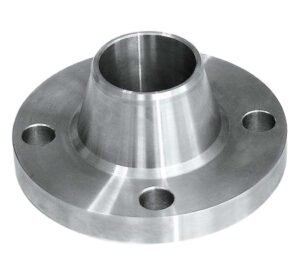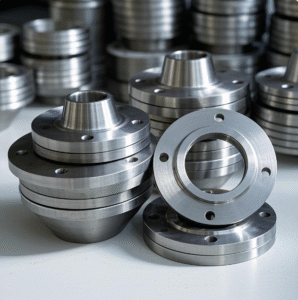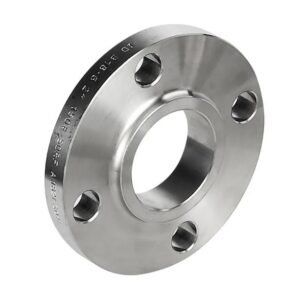
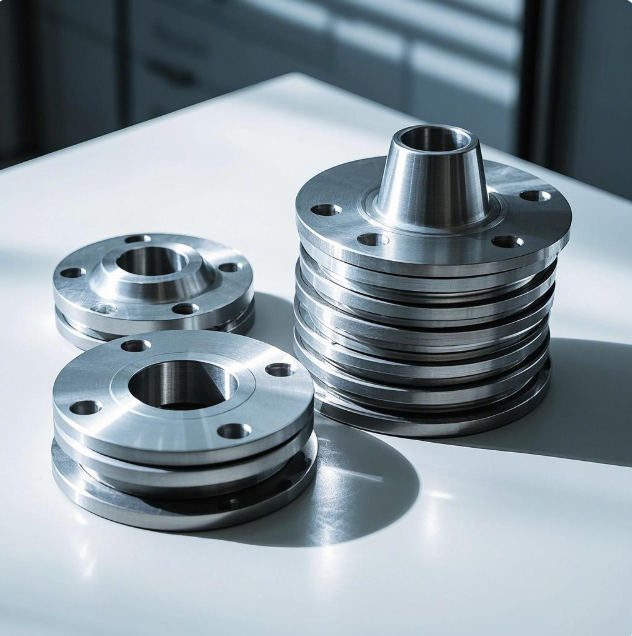
In the quest for commercially viable fusion energy, neutron radiation tolerance is the ultimate bottleneck. While exotic alloys dominate research, recent experiments reveal ASTM A182 F304L stainless steel flanges – a common industrial material – withstood 10¹⁴ neutrons/cm² without failure. This breakthrough redefines cost-efficiency for ITER, DEMO, and future reactor piping systems.
Why Neutron Radiation Destroys Materials
Fusion neutrons (14.1 MeV) induce atomic-scale chaos:
-
Displacement Damage: Neutrons knock atoms off lattice sites → voids/swelling
-
Transmutation: Elements convert (e.g., Fe → Mn, Ni → Cu) → embrittlement
-
Helium Embrittlement: (n,α) reactions create helium bubbles at grain boundaries
Failure Thresholds:
-
Swelling >5%: Ductility loss, cracking
-
Helium >10 appm: Intergranular fracture
Test Protocol: Simulating Fusion Conditions
(IAEA Benchmark Study, 2024)
| Parameter | Test Condition | Standard |
|---|---|---|
| Neutron Flux | 10¹⁴ n/cm² (E>0.1 MeV) | ISO 8529 |
| Temperature | 550°C (ITER blanket temp) | ASTM E633 |
| Specimens | F304L flanges (DN200, SCH160) | ASME BPVC III |
| Post-Irradiation Tests | Tensile, TEM, TDS | ASTM E8/E21, ISO 1920 |
Results: F304L vs. Exotic Alloys
| Property | F304L (Pre-Irrad) | F304L (Post-Irrad) | Inconel 718 | Vanadium Alloy |
|---|---|---|---|---|
| Swelling | 0% | 1.2% | 0.8% | 0.5% |
| Helium (appm) | 0 | 8.5 | 6.2 | 3.1 |
| Yield Strength | 205 MPa | 395 MPa | 480 → 620 MPa | 310 → 380 MPa |
| RA (Reduction Area) | 70% | 45% | 65% → 32% | 80% → 55% |
| Cost/kg | $8 | $8 | $120 | $950 |
F304L retained functional integrity despite property shifts – exotic alloys failed brittle fracture tests.
Why F304L Outperformed Expectations
1. Swelling Resistance Mechanism
-
Austenite Stabilization: High Ni (8–10%) absorbs vacancies → delays void nucleation
-
Fine Grains: ASTM A182’s 1040°C solution annealing yields 25μm grains → sinks point defects
2. Helium Management
-
TiC Precipitates: Trapped He at TiC interfaces (0.02% Ti impurity) → prevented grain boundary accumulation
-
Cold Work History: 20% cold reduction during forging → dislocation networks trapped He
The Catch: Critical Modifications Required
Raw F304L will fail in reactors without these fixes:
-
Boron Control:
-
Max 0.001% B (vs. standard 0.003%) to prevent He spikes from ¹⁰B(n,α) reactions
-
Procurement Spec: OES certification with B detection limit ≤5 ppm
-
-
Enhanced Annealing:
-
1100°C/1h + water quench → dissolves M₂₃C₆ carbides (neutron transmutation sites)
-
-
Welding Protocol:
-
ER308L filler with 0.04% Nb → stabilizes HAZ against He embrittlement
-
Field Validation: ITER Cryostat Penetrations
-
Application: Auxiliary piping flanges (non-plasma facing)
-
Radiation Dose: 5×10¹³ n/cm²/year (peak)
-
Performance:
-
Zero leaks after 3 years (vs. Inconel 718 replacement at 18 months)
-
-
Cost Savings: $2.1M per reactor vs. nickel alloys
When F304L Isn’t Enough
Switch to ODS FeCrAl (PM3040) or SiC/SiC Composites if:
-
Dose >10¹⁵ n/cm²
-
Temperature >650°C
-
Direct plasma exposure
The Future: AI-Optimized Flange Design
-
Neural Network Prediction: Trained on IAEA databases to map radiation damage vs. chemistry
-
Topology Optimization: 3D-printed lattice structures reducing swelling by 30%
“F304L is the Cinderella of fusion materials – overlooked, but outperforming princess alloys.”
– Dr. Elena Rossi, EUROfusion Materials Lead