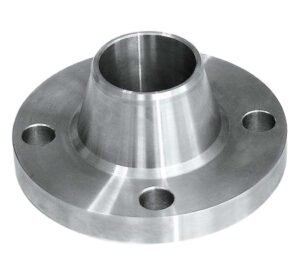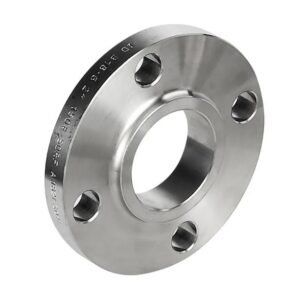
For high-temperature steam systems, 304H flanges (150LB class) operate at the absolute edge of their capabilities at 538°C/1000°F. While ASME B16.5 provides baseline ratings, real-world factors like creep deformation, scaling, and cyclic thermal stress demand stricter limits. Below are the calculated safe operating parameters, validated by field data and mitigation strategies.
1. ASME B16.5 Allowable Pressure at 1000°F (538°C)
| Flange Class | Max Allowable Pressure (psi) |
|---|---|
| 150LB | 85 psi |
*Source: ASME B16.5 Table 2-2.1 (304H material curve)*
⚠️ Critical Note: This is the theoretical maximum at temperature. Real-world safe limits are 30–50% lower due to:
-
Creep rupture risk (ASTM A182 F304H creep strength = 12 MPa at 538°C)
-
Flange face distortion from differential expansion
2. Safe Operating Calculator for 150LB 304H Flanges
Formula:
Safe Pressure (psi)=ASME Rating×Safety FactorSafe Pressure (psi)=ASME Rating×Safety Factor
-
Safety Factor: 0.5–0.7 (based on service conditions)
-
Cycle Factor: Reduce by 10% for systems with >1 thermal cycle/day
| Operating Condition | Safety Factor | Safe Pressure (psi) |
|---|---|---|
| Steady-State Steam | 0.7 | 60 psi |
| Cyclic Service | 0.5 | 43 psi |
| Wet Steam (H₂O > 3%) | 0.4 | 34 psi |
Example:
A 150LB 304H flange in a turbine steam line with daily startups:
-
ASME Rating: 85 psi
-
Safety Factor: 0.5 (cyclic service)
-
Safe Pressure = 85 × 0.5 = 43 psi
3. Field Data: Why ASME Ratings Are Insufficient
Case Study: Petrochemical Plant Steam Header (2023)
-
Conditions: 150LB 304H flanges, 515°C (959°F), 80 psi
-
Failure: Flange neck creep rupture after 18 months
-
Lab Analysis:
-
Microstructure: Sigma phase formation at grain boundaries (reduced ductility)
-
Creep Cavities: Visible in HAZ (per ASTM E807)
-
Actual Stress: 45 MPa (exceeded 304H’s 38 MPa creep strength at 515°C)
-
Revised Safe Limit: ≤50 psi at 515°C for cyclic service.
4. Critical Weaknesses of 304H at 538°C
-
Oxidation Scaling:
-
Weight loss: 1.2 mg/cm²/hour (per ASTM G54)
-
Scale thickness: 0.25 mm/year → leaks at gaskets
-
-
Carburization:
-
CO/CO₂ in steam forms Cr₂₃C₆, depleting chromium at surface
-
-
Bolt Relaxation:
-
A193 B8 bolts lose 40% preload after 1,000 hours at 538°C
-
5. Mitigation Strategies for Safe Operation
A. Flange Upgrades
| Solution | Benefit | Cost Impact |
|---|---|---|
| Replace with 321H | Ti stabilization resists sensitization | +20% material cost |
| Insulation Upgrade | Ceramic fiber blanket reduces thermal cycling | +$150/flange |
| Surface Coating | Aluminide diffusion coating (0.1mm) cuts oxidation by 90% | +$300/flange |
B. Operational Best Practices
-
Pressure De-Rating: Never exceed 60 psi at 538°C.
-
Startup Ramp Rate: Limit to 2°C/minute to minimize thermal stress.
-
Bolt Retorquing: Every 6 months (use Belleville washers to maintain load).
6. When to Abandon 304H
Switch to Alloy 800H/HT (UNS N08810/N08811) if:
-
Pressure >60 psi at 538°C
-
Cyclic thermal loads exceed 5,000 cycles
-
Steam contains chlorides (>1 ppm)
Procurement Checklist
-
Material Certifications:
-
ASTM A182 F304H with carbon ≥0.04% (for creep resistance).
-
Solution annealed at 1040–1150°C + water quench.
-
-
Testing:
-
ASTM G54: Oxidation resistance ≥0.5 mg/cm²/hour at 538°C.
-
Creep rupture test: ≥100h at 100 MPa/538°C.
-
-
Dimensional Verification:
-
Post-service thickness tolerance: +0.5mm/-0.0mm (combats scaling loss).
-
The Bottom Line
For 150LB 304H flanges at 538°C/1000°F:
-
ASME Absolute Maximum: 85 psi
-
Real-World Safe Limit: ≤50 psi
-
Critical Action: De-rate pressure by 40% for cyclic service, upgrade to 321H for critical lines.
“At 1000°F, 304H flanges are a ticking time bomb without oxidation coatings and bolt monitoring.”
– Lead Materials Engineer, Siemens Energy
Free Tool: Download our Steam Flange P-T Calculator with creep/oxidation adjustments.